Why Independent Service Providers Will Out-Earn Full-Time Employees in the Future of Work
Future of work trends show independent service providers and freelancers are poised to out-earn full-time employees. Learn why, see the data, and discover how to build scalable income streams.

Why Independent Service Providers Will Out-Earn Full-Time Employees in the Future of Work
The nature of work is undergoing a structural transformation. What was once a stable, salary-based system is rapidly evolving into a dynamic, market-driven economy where individuals operate as independent service providers rather than traditional employees.
While full-time employment has long been considered the safest path to financial stability, emerging data and tools now point to a different future—one where independent professionals consistently out-earn their salaried counterparts.
This shift is not theoretical. It is already underway—and platforms like RateCards are accelerating it.
The Rise of Market-Based Talent
Traditional employees are compensated within predefined salary bands. Their income is tied to job titles, internal pay structures, and incremental raises that typically range between 3% and 10% annually.
Independent service providers operate under a different model. Their income is determined by market demand, perceived value, and outcomes delivered—not time spent.
Freelancers already generate approximately $1.5 trillion annually in the U.S., and median earnings have reached around $85,000—slightly surpassing traditional employees.
More importantly, top-tier independents routinely exceed $100,000 and scale far beyond.
Why Independents Have a Structural Advantage
1. Pricing Power vs. Salary Constraints
Employees are limited by salary bands and promotion cycles.
Independent providers control pricing.
They can:
- Increase rates based on results
- Package services into higher-value offers
- Charge based on outcomes instead of hours
Modern tools like what a link in bio with payments really costs allow freelancers to present structured offers (rate cards) instead of negotiating ad hoc pricing—dramatically increasing perceived value.
2. Multi-Income Stream Potential
Full-time employees rely on a single income source.
Independent professionals can build multiple streams:
- Retainers
- One-time projects
- Consulting
- Digital products
- Recurring services
Platforms like a single link-in-bio page that takes bookings and payments enable independents to centralize all these offers into a single monetization hub, turning a simple profile into a revenue engine.
Some freelancers using these systems generate between $2,000–$15,000/month from automated service funnels alone.
3. Global Market Access
Employees compete locally.
Independent providers compete globally.
This means:
- Access to higher-paying clients
- Ability to arbitrage geography
- Greater demand for specialized skills
A freelancer in one region can now earn premium rates from clients anywhere in the world—especially when equipped with frictionless payment tools like RateCards payment links for services.
4. AI as a Force Multiplier
Independent professionals are adopting AI faster than traditional employees.
This allows them to:
- Deliver work faster
- Handle more clients
- Increase margins without increasing hours
The result: higher income per individual.
5. Corporate Shift Toward Flexible Talent
Companies are reallocating budgets:
- Away from fixed salaries
- Toward flexible, on-demand talent
This shift is driven by:
- Cost efficiency
- Speed
- Access to specialized expertise
Independent providers—especially those with clear service offerings and pricing—are capturing this demand.
The Income Trajectory Gap
Over time, the earning gap becomes more pronounced.
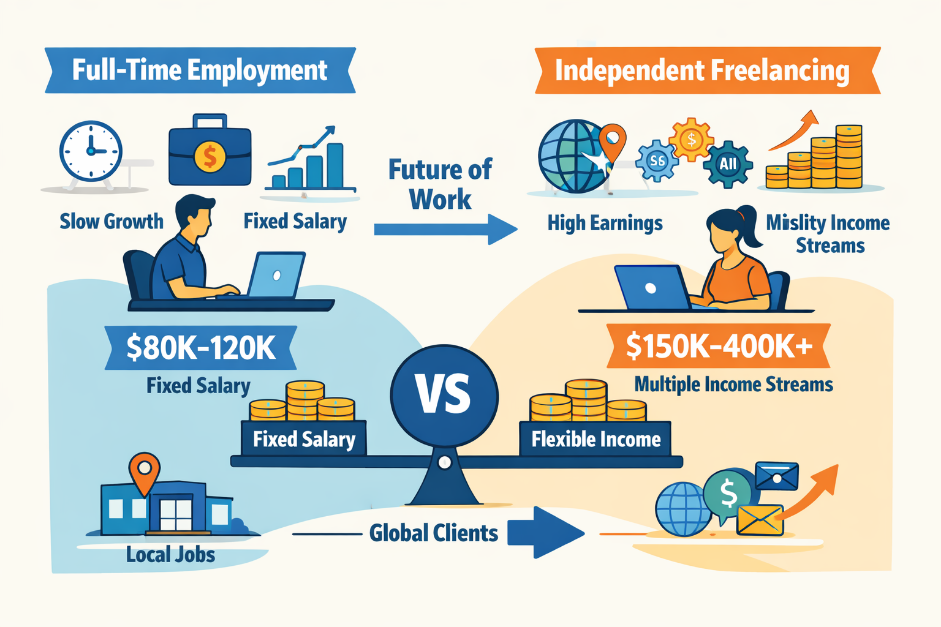
Full-Time Employee (Typical)
- Year 1: $80,000
- Year 5: $100,000–$120,000
Independent Professional (Strategic)
- Year 1: $60,000–$90,000
- Year 3: $120,000–$180,000
- Year 5: $200,000–$400,000+
The upside is significantly higher due to:
- Pricing flexibility
- Multiple income streams
- Scalable systems
The Infrastructure Enabling This Shift
This transformation is not just behavioral—it is technological.
Historically, freelancers faced:
- Platform fees (10–20%)
- Fragmented tools
- Manual admin work
Today, tools like RateCards.app eliminate many of these barriers by enabling:
- Direct payments
- Service packaging
- Automated invoices
- Booking systems
- Recurring revenue models
This reduces friction and increases net income.
Who Wins in This New Economy
Not all freelancers will outperform employees.
High Performers:
- Specialists with in-demand skills
- Outcome-focused service providers
- AI-augmented professionals
- Those with strong positioning and distribution
Those at Risk:
- Generalists offering commoditized services
- Task-based workers vulnerable to automation
The key differentiator is not freelancing itself—it is how you operate within it.
A Practical Path to Out-Earning Employment
Phase 1: Positioning
Define a clear outcome: "I help [specific client] achieve [specific result]."
Phase 2: Build Your Offer Stack
Create structured services:
- Packages
- Retainers
- Tiered pricing
Use tools like structured rate cards to present offers clearly and professionally.
Phase 3: Monetization Infrastructure
Set up:
- Payment links
- Booking systems
- Automated workflows
A single optimized "link in bio" can act as a full client acquisition funnel.
Phase 4: Scale with Leverage
Introduce:
- Subcontractors
- Productized services
- Digital assets
The goal is to separate income from time.
Risks to Consider
The independent path includes:
- Income variability
- No employer-provided benefits
- Self-managed taxes and insurance
However, for those who build systems and leverage tools effectively, the financial upside outweighs these risks.
The Bottom Line
The future of work is shifting from jobs to services—and from employment to independent value creation.
Independent service providers are positioned to out-earn full-time employees because they:
- Operate in open markets
- Build multiple income streams
- Leverage technology and AI
- Price based on value
- Benefit from increasing corporate demand
Most importantly, they now have access to infrastructure—like RateCards.app—that turns individual skills into scalable, monetizable businesses.
This is not just a trend.
It is a fundamental redefinition of how income is created.
And those who adapt early will not just participate in the future of work—they will dominate it.
Where to go next
Frequently asked questions
Why can independent providers earn more than employees?
Because their income is set by the market rather than by a salary band. An employee's raise is typically a few percent a year within a fixed structure; an independent can reprice their work whenever their value rises, and can serve more than one client at a time.
What is the biggest structural advantage independents have?
Pricing power. Employees sell time at a rate someone else sets; independents sell outcomes at a rate they set. That is why efficiency gains flow to the independent — working faster raises their effective hourly rate rather than simply freeing capacity for their employer.
What are the risks of going independent?
Income volatility, no employer-provided benefits, and full responsibility for finding work. These are real, and they are what recurring clients, cash reserves, and structured pricing exist to manage. Independence raises the ceiling and lowers the floor.
How does someone start earning more as an independent?
Position around a specific problem rather than a general skill, build a defined offer with published prices, put payment infrastructure in place so buying is frictionless, and then add leverage — recurring plans, packages, or subcontracted help — so income is not purely a function of your hours.